
Define your risk thresholds
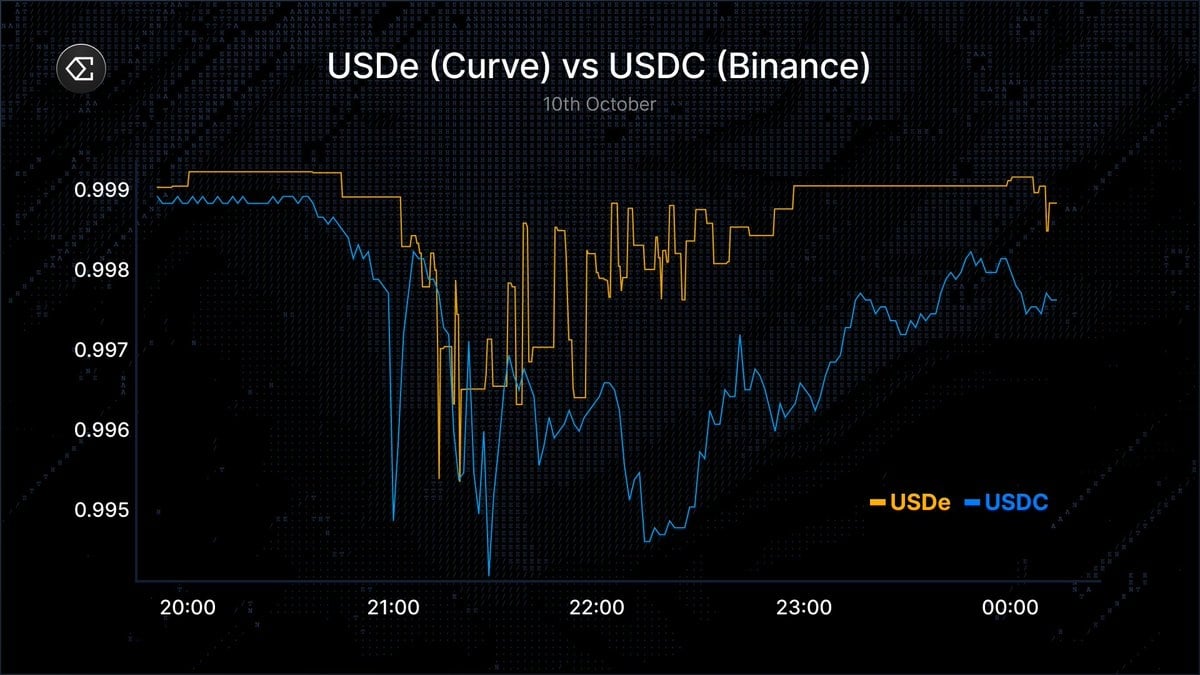
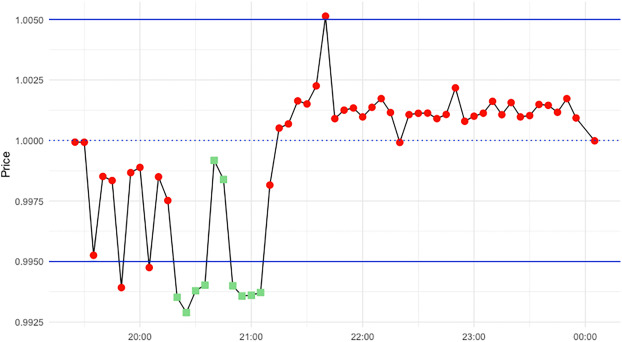
Treasury operators must distinguish between normal market friction and genuine solvency risk. Stablecoins fluctuate based on liquidity depth and exchange order book dynamics. A deviation of ±1% is standard volatility, often resolving within minutes as arbitrageurs rebalance prices. Treating every minor dip as a critical alert creates noise fatigue, causing your team to ignore actual threats.
However, sustained breaks below key psychological levels require immediate intervention. Define your "critical zone" based on the specific coin's historical behavior and your treasury's liquidity needs. For most USD-pegged assets, a drop below $0.98 signals a structural break in confidence rather than temporary slippage. This threshold triggers automated sell orders or collateral rebalancing to protect principal value.
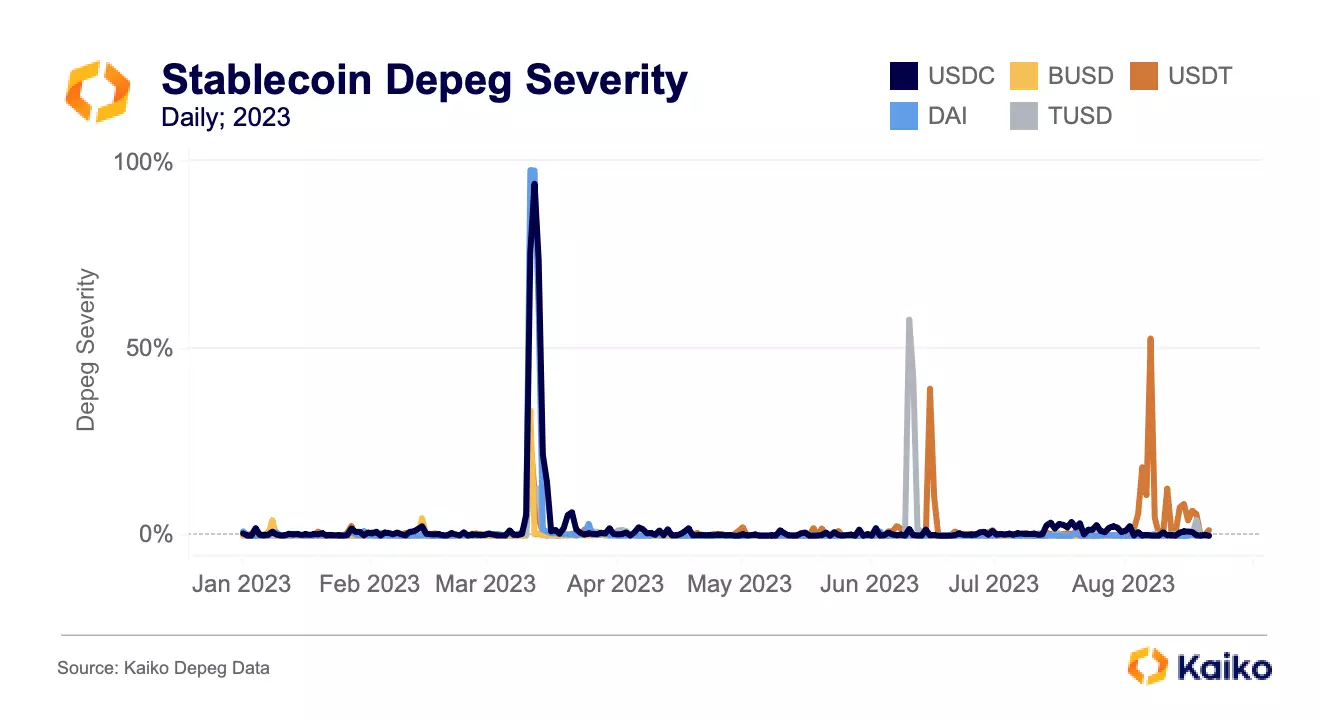
The March 2023 USDC depeg provides a clear operational lesson. When the bank holding Circle’s reserves failed, USDC briefly traded at $0.87 due to fears about reserve backing. While the peg recovered quickly after government intervention, the event demonstrated how quickly a variance can escalate into a systemic crisis. If your treasury holds significant exposure, you must have a pre-defined protocol for such events, including immediate redemption channels and emergency stablecoin swaps.
Set these thresholds in your monitoring dashboard with clear escalation paths. A 2% drop might warrant a team Slack notification, while a 5% drop should trigger an automated halt on new deployments. By defining these boundaries in advance, you remove emotional decision-making from the equation during high-pressure market events.
Configure real-time monitoring tools
Treasury operators cannot rely on manual checks or daily reports. When USDC depegged to $0.87 in March 2023, the window between the initial price drop and Federal Reserve intervention was measured in minutes. During that window, liquidity evaporated across multiple venues. To protect your treasury, you must build an automated infrastructure that detects deviations before they become solvency crises.
Start by selecting a data aggregator that provides sub-minute price feeds from multiple centralized and decentralized exchanges. Relying on a single source creates a blind spot; if one exchange experiences a glitch or a flash crash, your alerts might trigger falsely or fail to trigger. Tools like Webacy or Chainlink Price Feeds offer cross-venue aggregation that smooths out these anomalies. Ensure your chosen provider supports webhooks, allowing alerts to flow directly into your treasury management system or incident response channel without manual polling.
Next, configure your alert thresholds based on your risk tolerance. A 0.5% deviation from the peg is often sufficient to trigger a "watch" status, while a 1% deviation should trigger an immediate "action" protocol. Do not set thresholds too tight; minor fluctuations are normal in low-liquidity environments. Instead, focus on sustained deviations. For example, if the price remains below $0.995 for more than 30 seconds across three major venues, treat it as a confirmed depeg event. This reduces noise while ensuring you catch genuine instability.
Finally, test your entire pipeline end-to-end. Simulate a depeg scenario by manually triggering a test webhook or using a testnet environment. Verify that your treasury software receives the signal, pauses automated swaps, and notifies the on-call operator. If your alerts rely on email, assume they will be delayed or lost during a market crash. Use a redundant channel like PagerDuty, Slack, or Telegram for critical alerts. This setup ensures that when the next market shock hits, your response is automatic, not reactive.
Choose a provider that aggregates prices from multiple CEXs and DEXs. This prevents false alarms caused by single-exchange glitches. Look for providers that offer sub-minute latency and historical data for backtesting your thresholds.
Configure your treasury software or incident response platform to receive real-time webhooks from your data aggregator. Avoid polling APIs, which are too slow for depeg events. Ensure your webhooks are secured with signatures to prevent spoofing.
Set a "watch" threshold at 0.5% deviation and an "action" threshold at 1%. Require the deviation to persist for at least 30 seconds across multiple venues to filter out flash crashes. Document these thresholds in your treasury policy.
Simulate a depeg event by triggering a test webhook. Verify that the alert reaches your primary and secondary notification channels (e.g., Slack and PagerDuty). Confirm that your treasury software automatically pauses risky operations upon receiving the signal.
Set up multi-channel notification channels
A single alert channel is a single point of failure. When stablecoins depegged in March 2023, the speed of information was the only variable treasury operators could control. If your Slack bot is down, your email is buried, or your SMS provider has latency, you lose the window to rebalance or halt withdrawals. You need redundancy.
Build a triad of notifications: Slack for immediate team awareness, email for audit trails, and SMS for critical, non-negotiable alerts. This ensures that if one channel fails or is ignored, the treasury team still receives the signal to act.
Connect your stablecoin monitoring tool to a dedicated Slack channel (e.g., #treasury-alerts). Use webhooks to push JSON payloads directly when a depeg threshold is breached. This allows your team to see the alert alongside other operational data without switching contexts. Test this by manually triggering a test event to ensure the message formats correctly.
Email provides a searchable, timestamped record of when alerts were received. Configure your monitoring service to send HTML-formatted emails with clear subject lines, such as [CRITICAL] USDC Depeg Alert: $0.98. Include links to the relevant on-chain explorer so operators can verify the data immediately. This is crucial for post-event audits and compliance reviews.
SMS is your last resort for immediate, high-urgency communication. Reserve this for severe depeg events (e.g., below $0.95) where minutes matter. Use a reliable provider like Twilio or AWS SNS. Ensure the phone numbers are updated regularly and that your team has tested the delivery path. Avoid SMS for minor fluctuations to prevent alert fatigue.
Test this entire system by simulating a depeg event. Verify that all three channels fire simultaneously and that the content is accurate. Redundancy is not just about having multiple channels; it is about ensuring they all work when the market moves.
Execute the response protocol
When a depeg alert confirms, the treasury operator must shift from monitoring to containment immediately. The goal is to preserve capital and maintain operational liquidity before the wider market reacts. Treat the alert like a circuit breaker: isolate the affected asset, freeze exposure, and execute the exit strategy defined in your risk framework.
1. Halt inflows and pause redemptions
The first step is to stop all new deposits of the depegged stablecoin into your treasury wallets. If your protocol or treasury allows user redemptions, pause them to prevent a run on your reserves. This buys time to assess the damage without the pressure of continuous outflows.
2. Assess and hedge exposure
Calculate your total exposure to the depegged asset across all wallets and smart contracts. If you hold significant reserves, consider moving them to a more stable asset (e.g., USDC or USDT) via a pre-approved, low-slippage route. Avoid panic selling on volatile DEX pools where slippage could erase value. Review the Federal Reserve’s analysis of the bank failure as a case study in how bank runs trigger stablecoin depegs.
3. Communicate and document
Notify your team and stakeholders. Document every action taken for audit trails. Transparency reduces speculation and panic among users or investors.
-
Halt all inflows of the depegged asset
-
Pause user redemptions if applicable
-
Calculate total treasury exposure
-
Execute exit strategy to stable assets
-
Notify team and document actions
Common stablecoin depeg: what to check next
Stablecoin depegs are rare but operationally critical events. Understanding the mechanics and immediate responses helps treasury operators limit slippage and preserve capital during market stress.

No comments yet. Be the first to share your thoughts!